
Map Route / Forward
**Forward rules** (Map Route) match a Host or Host + Path prefix and send requests to another machine, protocol, or port. The client keeps the original URL; Capture, Mock, and page debugging honor the same rules.
When to use it
Common scenarios:
- **Forward rules**: point a production API to localhost or staging (client URL unchanged).
- **Param transform**: decrypt encrypted params for reading and Mock.
- **Mock**: temporarily change request or response content.
Combine all three—**no phone hosts file or in-page API base URL change**.
What it does and does not do
Each rule is “match host[/path] → target address”. On hit DevPeek only changes **which server actually receives the request**, not:
- The URL in the browser or app, and the original URL in the capture list. A target without `http(s)://` keeps the original Host; a scheme makes Host follow the target.
- The **original** URL/host shown in the capture list and detail panes.
- Bodies themselves (unless Mock or param transform handles them later).
When it applies
Traffic must go through DevPeek. Saves apply to **new connections / requests**. Several configs can be enabled at once: the list is an overlay stack, and a lower enabled config that matches covers every config above it. Within a config, the longest path prefix wins; equally specific lines use the later line.
A common pattern maps a production HTTPS hostname to a local HTTP server, e.g. `api.example.com` → `http://localhost:3300`. The client still uses HTTPS; DevPeek must decrypt that hostname first (root CA trusted on the device, host in the SSL allowlist), then connect to the local port over plain HTTP. Local dev servers usually speak HTTP only—write the target with an `http://` prefix.
Rule syntax
Rules are plain text, one per line:
- Format: `host[:port][/path-prefix]` + **tab or space** + `target host[:port]` or `http(s)://host[:port]`.
- Lines starting with `#` are comments; disabling a row in the sidebar adds `#` at the front—saved immediately.
- Host supports wildcards. Path is a prefix match and the longest prefix wins; `api.example.com/v2/orders` does not affect `/v1/users`. A match-side port restricts that rule; no port matches any port.
- Target port precedence is explicit port → target scheme default → request port. Local dev servers usually speak HTTP, so write `http://localhost:3300` explicitly.
- Without `http(s)://`, only the connection address changes and the original Host stays. With a scheme, Host follows the target. A local config can also paste hosts lines: `IP hostname [aliases...]`.
- A directory target (trailing `/`) keeps that slash when the path matches exactly. Forwarding to `localhost` keeps the hostname and falls back among local addresses; an explicit IP connects to that address.
Example
# Forward rules
# Each line: match pattern → target host[:port]; lines starting with # are comments
# Longest path wins; equally specific lines use the later line
# hosts lines are also accepted: IP hostname
#
api.example.com/v2/orders	http://127.0.0.1:8080
*.staging.example.com	localhost:3000
h5.example.com	http://localhost:3300
Configure and manage
Entry 1: title bar Proxy → **Forward rules** (standalone window, can sit beside Capture).
- Entry 2: the **Forward** panel on the right rail—toggle a whole config, expand its summary, and drag to reorder configs. Rows in a disabled config show that they are inactive.
- Entry 3: list context menu **Forward to…** prefills the match address into the current local config. Remote configs cannot take manual rows.
- Capture **Overview** shows **Forwarded URL** when a session hit a rule; click to open the editor on that line.
- Rules export/import with app config. Local text saves on blur or Ctrl/Cmd+S and applies to new connections.
The side panel toggles configs and shows summaries; edit the full text in the forward-rules window. Remote configs are read-only in the panel.
**Proxy → Forward rules** plain-text window: one Host or Host + Path mapping per line; can sit beside Capture.
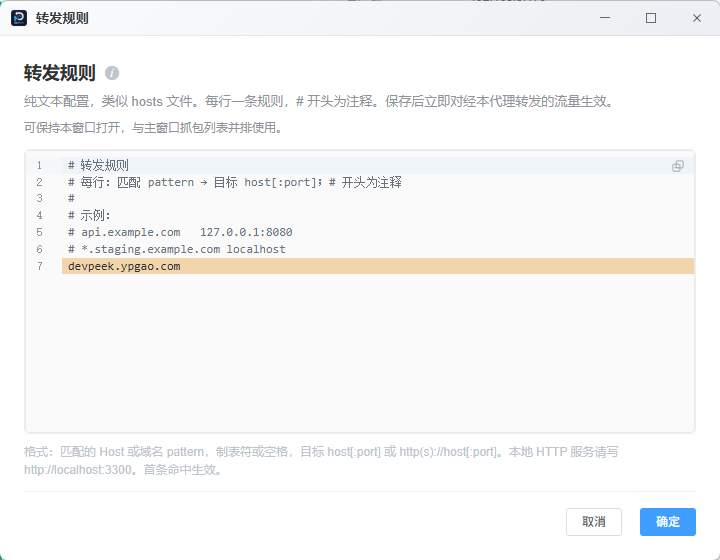
Stacked configs
Several configs can be enabled together. Top to bottom is an overlay stack: upper configs are the base, and a lower enabled config that matches the request covers everything above it, including a longer path. Within a config, the longest path prefix wins; equally specific lines use the later line. To override one host or path from a subscription, put the local config below the remote one.
Remote subscription
When creating a config, choose Remote and enter an http or https URL. With “Source is a hosts file”, the fetch becomes match → target rules and skips `0.0.0.0`. A remote config is a read-only snapshot; the next refresh replaces it, and a failed refresh keeps the last successful copy. Refresh manually, or turn on auto-update (every hour). A refresh resolves the subscription URL only with schemeless rules from enabled configs above this one.
Physical NIC
Each config can use “Direct via physical NIC”. Proxy traffic for that config, and remote refreshes, then use the physical NIC and only public IPv4 hosts mappings, which bypasses fake-ip on macOS utun or Windows WinTun. This can also bypass a VPN or system proxy policy—turn it on only when you need it.
In capture
Rows still show the client’s original host/URL for filtering and search. When forwarded, **Overview** adds **Forwarded URL** (full upstream URL including path) so you can see where the request actually went.
Mock still matches URLs you see in capture. If Mock or Debug API should hit the forwarded service, confirm the forward target is correct.
Filters, response search, and resend all work on forwarded sessions—see Capture UI & requests.
For page debugging
Mobile web debugging shares the same proxy. Typical flows:
- Phone H5 still calls `https://api.example.com`; Map Route sends that Host to `http://127.0.0.1:8080` without editing the page.
- The Debug tab mirrors pages loaded through the proxy; the network panel and capture list show the same forwarded hops.
- Combine with Mock: Map Route to a local stub, then Mock specific paths—no public deploy needed.
Proxy, certificate trust, and SSL scope still required first—see Mobile web debugging.
Combine with other features
Typical joint-debug flow: set up forwarding (point to localhost) → add param transform if needed (read plaintext) → enable Mock if needed (fake responses). If the target is wrong, check **Forwarded URL** in Overview.
HTTPS, SSL decrypt, and local HTTP
For client HTTPS, DevPeek decrypts first (host must be in the SSL allowlist), then applies forward rules. When pointing at a local HTTP service, use an `http://` target.
If nothing answers after forward: verify the local listener, firewall, and that the **phone** trusts the DevPeek CA—not only the PC.
Limits
- Affects **new requests** after you save; refresh the page or restart the app if an open session still hits the old target.
- A lower enabled config that matches covers every config above it. Within a config, equally specific lines use the later line. Put exceptions below the config you want to override.
- Map Route changes scheme and upstream host:port only. Original Path and Query continue to the target; the matched prefix is not stripped automatically.
Troubleshooting
- Rule ignored: saved? pattern matches Host? line commented with `#`?
- Still hits production: a lower enabled config may be covering this rule. Clear connections and retry.
- HTTPS page to local HTTP fails: use `http://` target; check SSL allowlist and certs.
- No Forwarded URL in Overview: no enabled rule hit, or target equals original host:port.
Map Route steers production hostnames to your machine or staging—use only with authorization; do not point third-party domains at untrusted services.